KEY SCIENCE ISSUE While Arctic sea ice cover has been diminishing over the last 30 years, the loss of ice has accelerated dramatically since 2002, culminating in the enormous drop in summer sea ice extent observed in 2007. This loss of sea ice is expected to have profound impacts on the marine communities that inhabit the Arctic Ocean, although few of these impacts have yet to be rigorously documented. In this study, scientists from Stanford University in Palo Alto, Calif., set out to see what effect reduced sea ice cover would have on the organisms that comprise the base of the Arctic marine food web, the single-celled floating algae called phytoplankton. Because these photosynthetic organisms rely on the sun to meet their energy demands, reduced Arctic sea ice cover means an increase in the amount of open water habitat suitable for algal growth. Thus, their abundance is expected to increase.
FINDINGS Not surprisingly, the scientists found that the growth of phytoplankton has indeed increased markedly in concert with the rapid reduction in sea ice cover over the last five years. However, they were surprised to find that this growth did not take place in the areas of the Arctic where we expected it. The researchers anticipated that areas experiencing the most dramatic loss of sea ice would show the largest increase in algal growth. However this was not the case. Algal growth did indeed rise in newly ice-free areas, but only accounted for about one third of the total Arctic increase. The majority of the increase in algal growth (70 percent) was observed in the shallow waters that ring the Arctic Ocean. In these areas, algal growth rates increased because the sea ice cover was melting sooner and freezing later in the year, giving the algae increasingly more time to grow.
METHOD This study was conducted using nine years of satellite imagery from the Sea-viewing Wide Field-of-view Sensor to study ocean color, the Moderate Resolution Imaging Spectroradiometer to assess ocean color and
temperature, the Advanced High Resolution Radiometer to evaluatate ocean temperature, and the Special Sensor Microwave Imager to determine sea ice extent.
SIGNIFICANCE TO THE PUBLIC Arctic waters are a critical habitat for large numbers of organisms that rely on phytoplankton for food. Should the trends we report continue, phytoplankton growth in the Arctic could
easily double in the near future. Under the right conditions, they could increase by even more. However, while food supplies may be increasing, the loss of sea ice could precipitate profound ecological shifts away from predators
that require sea ice, such as the ringed seals and polar bears that dominate the system today, toward a more open water fauna. In addition, continued changes in the timing of sea ice melt could pose problems for organisms that
have evolved to utilize the seasonal pulse in phytoplankton abundance, either through migratory patterns that bring them to the Arctic at the most productive times of year or through life history strategies that ensure an ample
food supply for developing
young.
NEXT STEPS Future work in this area includes developing improved satellite-based algorithms for estimating algal abundance, conducting cruises to identify species-specific impacts of losses of Arctic sea ice, and investigating
the importance of the Arctic as a sink for atmospheric carbon dioxide.
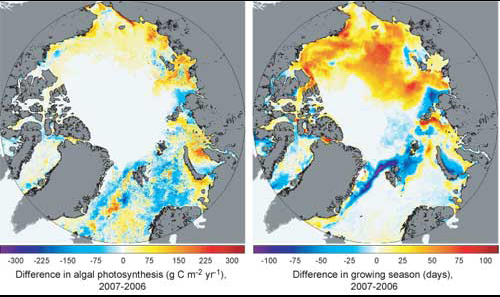
Differences in the rate of photosynthesis in algae between 2006 and 2007 correspond to differences in the duration of open water between 2006 and 2007. Clearly, longer growing seasons in the Arctic Ocean promote greater phytoplankton growth. This suggests that a more ice-free Arctic may be a more favorable habitat for phytoplankton growth than it has been in the past.
For more information, contact:
Louis Bergeron, Stanford University Public Affairs
Phone: 650- 725-1944/Email:louisb3@stanford.edu
