KEY SCIENCE ISSUE The Amazon’s tropical rainforests form a huge reservoir of biodiversity and play an enormous role in the cycling of carbon and water on this planet, yet their seasonal functioning and response to environmental change are poorly understood.
FINDINGS Scientists at the University of Arizona in Tucson recently discovered that Amazon evergreen rainforests display a unique and unexpected seasonal cycle that is opposite to what was previously thought. Rainforest
ecosystems thrive, remain moist, and become greener with the greater availability of sunlight in less cloudy, dry periods. The more cloudy rainy season has less sunlight available, which limits forest growth. They also discovered
a broken cycle of seasonality in cropland and pastures in previously deforested areas. Satellite data reveal a reversed cycle of seasonality, in which the surface becomes parched due to intense sunlight and insufficient rainfall
in the dry season. The rainforests survive dry periods by accessing deep soil water reservoirs through their mature deep root systems, whereas the shallow rooting systems found in deforested areas quickly exhaust minimal quantities
of soil moisture near the surface. The scientists broadened the study to look at rainforest response to a severe drought that impacted the Amazon in 2005, triggering the highest fire season ever. The increased fires were human-made
and originated in dried-out deforested areas. Surprisingly, the rainforests were more productive in areas where the drought was most severe. Thus, the 2005 drought simultaneously produced greener rainforests and drier, more flammable,
deforested areas.
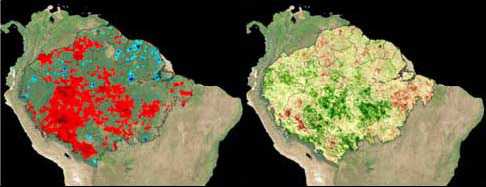
NASA's satellite data depicts the rainfall anomaly that impacted the Amazon basin in 2005 (left). Red colors indicate areas in the Amazon most impacted by the drought. Satellite data also show anomalous forest activity in 2005 (right). The green colors indicate areas in the Amazon that became greener and more productive in 2005, in response to the greater availability of sunlight, while red colors represent areas that were negatively affected by the drought and yellow colors mean there was no significant response.
METHOD Satellite data from the highly calibrated NASA Moderate Resolution Imaging Spectroradiometer was used to map and monitor the forests and disturbed areas in the Amazon basin. Daily images of vegetation chlorophyll
activity, or greenness, were processed into bi-monthly images in order to remove clouds and correct for atmospheric conditions. The scientists generated seasonal profiles for every pixel in the Amazon basin from the year 2000 to
present, and compared the seasonality of rainforests with deforested areas. In-situ flux data measured from towers were used to validate the findings.
SIGNIFICANCE TO THE PUBLIC This discovery has led to a new understanding the natural functioning of Amazon rainforests. These forests are more resilient and better able to withstand climatic variability, such as drought,
than previously thought. However, with prolonged droughts and increasing human disturbance, a reversal in seasonal vegetation activity may occur, and the forests will no longer remain moist during dry periods, with consequences
of intensified fire vulnerability, threatened biodiversity, and potential to release large quantities of carbon into the atmosphere.
NEXT STEPS The researchers plan to further study the resilience of Amazon forests to environmental changes and determine thresholds of climate and disturbance that will cause abrupt shifts in seasonal cycles.
For more information, contact:
Mari Jensen, University of Arizona Public Affairs, 520-626-9635, mnjensen@email.arizona.edu
