KEY SCIENCE ISSUE Global demand for food and fiber is increasing the pressure on Amazon forests from agriculture and logging. New actors, including large commercial farms and mechanized methods of clearing forest are changing the impacts from land use on forest ecosystems. Monitoring and assessing the aggregate impacts of logging and deforestation on Amazon ecosystems is a primary goal for scientists’ study of the Earth system and the global community focused on reducing greenhouse gas emissions from tropical deforestation and degradation and conserving species habitat.
FINDINGS Data from Landsat satellites, managed by NASA and the U.S. Geological Survey, and NASA's NASA's Moderate Resolution Imaging Spectroradiometer (MODIS) instrument are the basis for two new programs to monitor
Amazon forest ecosystems. Greg Asner of the Carnegie Institution, and colleagues analyzed Landsat data to show that selective logging in the Brazilian and Peruvian Amazon is nearly as extensive as deforestation. Although some logged
forests are eventually cleared, areas that remain forested retain the legacy of previous logging, evident in the changes to forest structure and species composition. This new approach to identify logging with Landsat data is now
part of the annual assessment of deforestation conducted by the Brazilian National Institute for Space Research (INPE). Daily observations of the Amazon from NASA’s MODIS instrument have also generated advances in our understanding
of the process of land cover change. Doug Morton of the University of Maryland in College Park, MD and colleagues demonstrated for the first time how satellite data can be used to identify each aspect of the deforestation process,
from real-time monitoring of initial clearing, burning, and subsequent use for pasture or cropland.
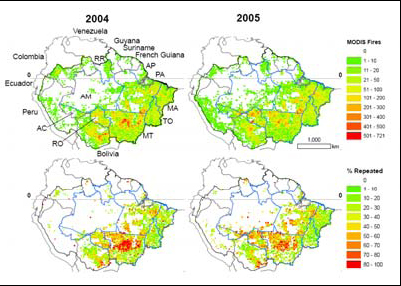
Total fire activity in the Amazon, detected by NASA’s MODIS instruments, is highest in southeast Bolivia and the Brazilian states of Mato Grosso, Rondônia and Pará during 2004-2005 (Top). Frequent fires in the same location are concentrated in central Mato Grosso (bottom), where peak deforestation for cropland in 2003-2004 led to large increases in fire activity. Credit: Morton et al. (in press), Global Change Biology
METHOD Time series of annual Landsat and daily MODIS data were used in this research.
SIGNIFICANCE TO THE PUBLIC Global markets strongly influence land use in the Amazon, and recent increases in demand for soybeans and beef have promoted deforestation for commercial agriculture. Combined damages from
logging and deforestation may double previous estimates of the forest area altered for the production of food and fiber each year. Global efforts to avoid climate change and loss of biodiversity have renewed the focus on tropical
forests. Using NASA technology, new techniques to search satellite data for selective logging and early stages of deforestation now provide timely scientific data and practical information for resource managers about the nature
and extent of changes to Amazon ecosystems.
NEXT STEPS Ongoing research is focused on the role of fire during deforestation to assess the cumulative impacts from logging, forest fires, and deforestation on forest regeneration. Related research will also improve
our understanding of the role of tropical deforestation in the global carbon cycle. The ultimate goal of this work is to use satellite data and ecosystem models to provide insights into how Amazon ecosystems may respond to future
land use and climate change and how, in turn, these responses affect the global climate.
For more information, contact:
Lee Tune, University of Maryland, University Communications, 301-405-4679, ltune@umd.edu
Lynn Chandler, Goddard Space Flight Center, 301-286-2806, lynn.chandler-1@nasa.gov
