KEY SCIENCE ISSUE Ocean organisms and biological processes, often referred to in short as “ocean biology,” are a vital part of Earth’s carbon cycle, contributing about half of global primary productivity.
As the global climate warms, ocean biology will change – but how, and why? By understanding how the atmosphere and ocean have changed in recent times, and how that has impacted ocean productivity, scientists will be better
able to understand how future climate change will affect the ocean’s ecosystems.
FINDINGS Using NASA satellite data, Jorge Sarmiento of Princeton University in Princeton, N.J., and colleagues have demonstrated the close links between ocean productivity and global trends in climate. Surface warming
increases the density difference, or vertical “stratification” of the ocean waters, leading to less mixing between the surface water layers, where phytoplankton live, and the deeper water layers, which contain the nutrients
they need to flourish. This is bad news for phytoplankton that live in the tropics where nutrient supply will be reduced due to less mixing and a shallower “mixed layer”, but good news for phytoplankton that live in
colder regions, where increasing temperature causes the growing season to start earlier in the year. Clearly, a changing global climate will have a different impact on ocean biology in different parts of the world.
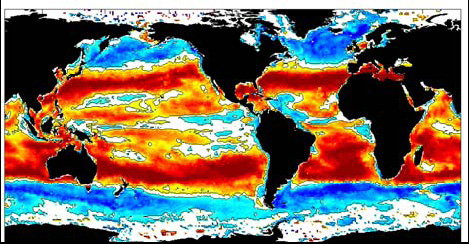
The plot shows a statistical measure of how phytoplankton and stratification are linked. Red areas are warm water regions where phytoplankton increase in response to weaker stratification. Blue areas are cold water regions where phytoplankton
increases in response to stronger stratification.
METHODS NASA Sea-viewing Wide Field-of-view Sensor (SeaWiFS) ocean color data were used to estimate chlorophyll-a, a pigment contained in phytoplankton. The depth of the mixed layer was determined from an ocean-atmosphere
model.
SIGNIFICANCE TO THE PUBLIC This work has increased understanding of how ocean biology will respond to climate change. Global warming will alter the distribution and productivity of the microscopic ocean plants, called
phytoplankton, and in turn, this will alter food webs and the distribution of consumer organisms and change the contribution of phytoplankton to CO2 uptake. The impact of climate change on phytoplankton is complex, but this work
is helping to reduce the uncertainty involved in predicting how ocean biology will respond to a warmer world.
NEXT STEPS Sarmiento and colleagues are continuing to examine how year-to-year changes in climate affect ocean productivity. This will help them to develop simple biological models that can be connected to more complex
climate models. They also plan to study the effects of seasons shifting in timing; spring blooming may be occurring earlier in the year in the sea, as well as on land, due to global warming. The continued availability of long-term,
large-scale ocean color data from NASA is absolutely vital for this research project, and others studying the effects of climate change on ocean biology.
For more information, contact:
Lynn Chandler, Goddard Space Flight Center, 301-286-2806, lynn.chandler-1@nasa.gov
